
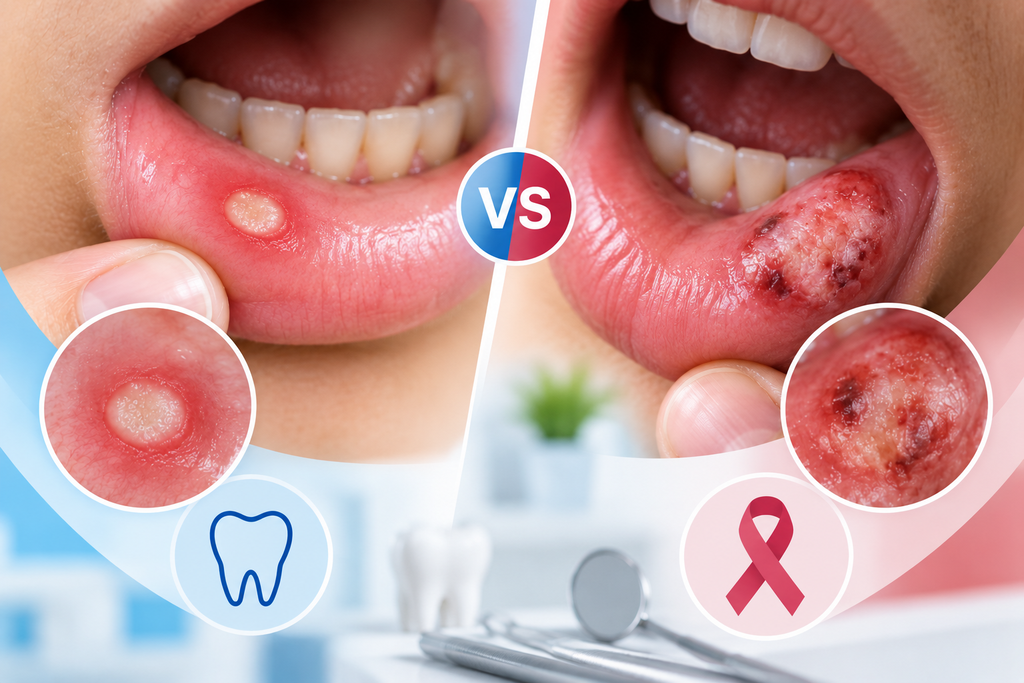
What Is a Mouth Ulcer?
A mouth ulcer is a break or sore in the soft tissue lining of the mouth. It can appear on the inner lips, cheeks, tongue, gums, or the roof of the mouth. Common causes include:
- Accidental biting or injury
- Irritation from sharp teeth or dental appliances
- Stress and fatigue
- Nutritional deficiencies (such as vitamin B12, iron, or folate)
- Certain infections
- Reactions to some medications
- Underlying systemic conditions
Most minor ulcers are painful but self-limiting. They typically heal within 7 to 14 days without leaving a scar.
What Is Oral Cancer?
Oral cancer refers to cancer that develops in the tissues of the mouth or oral cavity. It can affect the lips, tongue, gums, inner lining of the cheeks, floor of the mouth, and the roof of the mouth. It often begins as a seemingly harmless change — a small sore, a patch, or a lump — which is why awareness matters.
Oral cancer is treatable when detected early. This is why regular dental check-ups and prompt evaluation of persistent oral changes ideally with a mouth ulcer specialist in Cuttack are so important.
Mouth Ulcer vs Oral Cancer: What Is the Difference?
| Feature | Common Mouth Ulcer | Potentially Concerning Oral Lesion |
|---|---|---|
| Typical appearance | Round or oval, shallow, with a yellow-white center and red border | Irregular shape, raised edges, mixed red and white areas, or a lump |
| Pain | Often painful, especially when eating or drinking | May be painful or painless — absence of pain does not rule out concern |
| Healing pattern | Heals within 1–2 weeks | Does not heal or continues to worsen |
| Duration | Short-lived, recurrent episodes may occur | Persists beyond 2–3 weeks |
| Location | Commonly on inner lips, cheeks, tongue tip | Can occur anywhere, including floor of mouth, lateral tongue, back of mouth |
| Changes over time | Gradually shrinks and disappears | May grow, thicken, bleed, or change character |
| Associated symptoms | Usually none beyond local discomfort | Difficulty chewing, swallowing, speaking, jaw movement, or neck lump |
| When to evaluate | If recurrent or unusually severe | If persistent beyond 2–3 weeks or associated with warning signs |
Important: Appearance alone cannot confirm or rule out cancer. Only a qualified professional can evaluate and, if needed, recommend further testing.
5 Warning Signs That Need Dental Evaluation
- A sore or ulcer that does not heal as expected — If a mouth sore persists beyond 2–3 weeks, it deserves a professional look. This does not mean it is cancer, but it does mean it should be examined.
- A persistent lump, thickened area, or unusual patch — Any new lump or area of thickening in the mouth or neck that doesn’t resolve should be evaluated.
- Red or white patches that persist — These may be harmless, but persistent red or white patches in the mouth can sometimes be pre-cancerous or cancerous.
- Unexplained bleeding or persistent pain — Bleeding without an obvious cause, or pain that doesn’t improve, warrants attention.
- Difficulty chewing, swallowing, speaking, or moving the jaw/tongue These symptoms can have many causes, but persistent difficulty should be assessed.
How Long Does a Normal Mouth Ulcer Take to Heal?
Most uncomplicated mouth ulcers heal within 7 to 14 days. Some may take up to three weeks. If a sore persists beyond this window or worsens it’s time to see a dentist or oral specialist.
This timeframe is a general guide, not a rigid rule. Some benign conditions can cause longer-lasting ulcers. Conversely, not all persistent ulcers are cancer. The key is evaluation, not assumption.
What Causes Persistent Mouth Ulcers?
- Trauma or repeated irritation
- Sharp teeth or ill-fitting dentures
- Nutritional deficiencies
- Infections (viral, fungal, bacterial)
- Certain medications
- Systemic conditions (such as autoimmune diseases)
- Tobacco and alcohol exposure
- Other oral conditions
Persistent ulcers have many possible causes. A thorough clinical examination helps narrow them down.
Risk Factors for Oral Cancer
- Tobacco use (smoking, chewing, snuff)
- Areca nut/betel quid/gutkha use
- Heavy alcohol consumption
- Certain HPV infections
- Increasing age
- Previous oral lesions or cancers
- Other medically recognized risk factors
Having a risk factor does not mean you have oral cancer. It simply means awareness and regular check-ups are especially important.
When Should You See a Dentist or Oral Specialist?
Consider seeing a dentist if you notice:
- A mouth sore lasting more than 2–3 weeks
- A lump or thickening in the mouth or neck
- Persistent red or white patches
- Difficulty swallowing, chewing, or speaking
- Unexplained bleeding or numbness
- A feeling that something is stuck in your throat
A dentist will examine your mouth, ask about symptoms and risk factors, and recommend further steps if needed. If you’re looking for a mouth ulcer specialist in Cuttack, seeking timely professional evaluation is a responsible first step.
How Is Oral Cancer Diagnosed?
- Clinical examination of the mouth and neck
- Detailed oral examination of suspicious areas
- Imaging when appropriate
- Biopsy when clinically indicated
Only appropriate medical evaluation and when necessary, tissue examination can establish a diagnosis.
Can Mouth Ulcers Be Prevented?
- Avoid tobacco and areca nut products
- Limit alcohol
- Maintain good oral hygiene
- Avoid repeated trauma or irritation
- Address sharp teeth or poorly fitting dental appliances
- Eat a balanced diet
- Attend regular dental check-ups
Frequently Asked Questions
1. Can a normal mouth ulcer turn into oral cancer?
Ans :- A typical, short-lived mouth ulcer does not turn into cancer. However, a sore that persists or changes character should be evaluated to rule out other causes.
2. How long should a mouth ulcer normally last?
Ans :- Most heal within 7–14 days. If it lasts beyond 2–3 weeks, consult a dentist.
3. What does an oral cancer ulcer look like?
Ans :- It may appear as a non-healing sore, a lump, or a red/white patch. Appearance alone cannot confirm cancer.
4. Is a painless mouth ulcer more concerning than a painful one?
Ans :- Not necessarily. Painless does not mean harmless, and painful does not mean cancer. Persistence matters more than pain.
5. Can oral cancer occur without pain?
Ans :- Yes. Early oral cancer is often painless, which is why regular check-ups matter.
6. When should I see a dentist for a mouth ulcer?
Ans :- If it lasts more than 2–3 weeks, worsens, or is associated with lumps, bleeding, or difficulty swallowing.
7. Can tobacco or gutkha increase the risk of oral cancer?
Ans :- Yes. Tobacco and areca nut products are significant risk factors for oral cancer.
Conclusion
Most mouth ulcers are not cancer. They are common, often painful, and usually heal on their own. However, a persistent mouth ulcer, an unusual patch, a lump, or difficulty swallowing should never be ignored. Early professional evaluation whether by a dentist or a mouth ulcer specialist in Cuttack can provide clarity and peace of mind. When warning signs persist, timely consultation is not fear it’s responsibility.
Looking for Mouth Ulcer Treatment? Get an Expert Consultation
If you have a mouth ulcer that isn’t healing, don’t wait. A professional dental evaluation can help identify the cause and guide appropriate care. Early assessment ensures timely management and peace of mind.
Dr Chinmayee Kar : Your Dental Expert

Dr Chinmayee Kar is a trusted dental expert in Cuttack, offering advanced oral care, maxillofacial surgery, and implant treatments. With patient-focused diagnosis and modern techniques, she helps address mouth ulcers, oral lesions, and complex dental concerns with compassion and precision.
Dr Chinmayee Kar : Pearl Asthetics Dental Clinic
Address :- C446, Eye Hospital Road, above Urban Cooperative Bank, CDA Sector VI, Kataka, Odisha 753014.
Visit Location :- https://maps.app.goo.gl/ePvTgp6DRKkaySev5
Book an appointment today and get a proper consultation for your mouth ulcer