
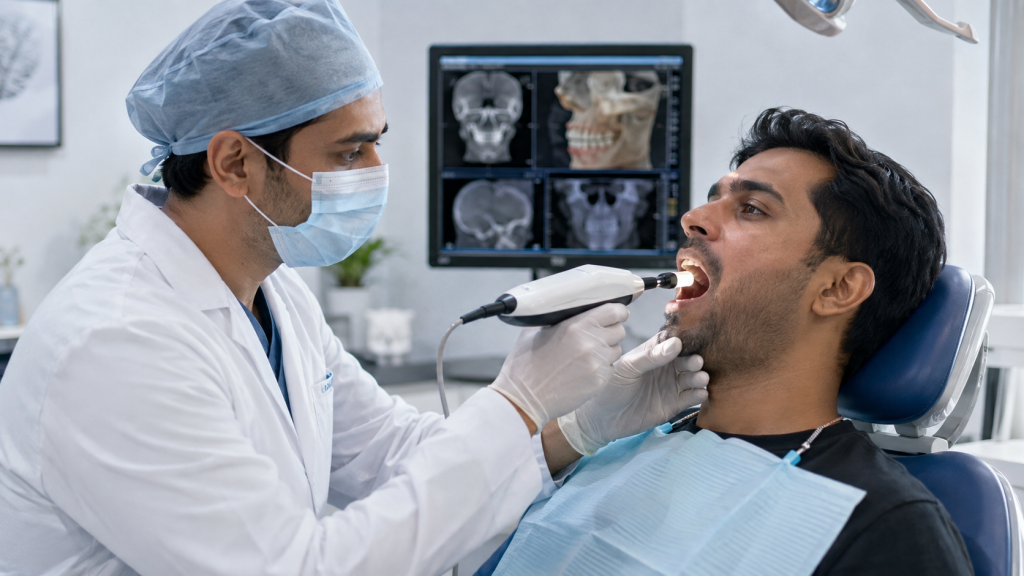
Have you been told you need wisdom tooth surgery? Are you experiencing persistent jaw pain that just won’t go away? Or perhaps you have been recommended dental implants but aren’t sure who to trust?
If any of these sound familiar, you might need to see an oral and maxillofacial surgeon.
But what exactly is oral and maxillofacial surgery? And how is it different from visiting a regular dentist?
This comprehensive guide will answer all your questions. Whether you are a patient, a parent, or simply someone looking to understand this specialty better, we will walk you through everything you need to know from common conditions treated to when you should consult a specialist.
Oral and maxillofacial surgery is a specialized branch of dentistry that deals with the diagnosis and surgical treatment of diseases, injuries, and defects affecting the mouth, teeth, jaws, face, and neck.
Think of it as the surgical arm of dentistry. While general dentists focus on routine dental care like cleanings, fillings, and crowns, oral and maxillofacial surgeons are trained to perform complex surgical procedures involving the hard and soft tissues of the face and jaw.
Who is an Oral and Maxillofacial Surgeon?
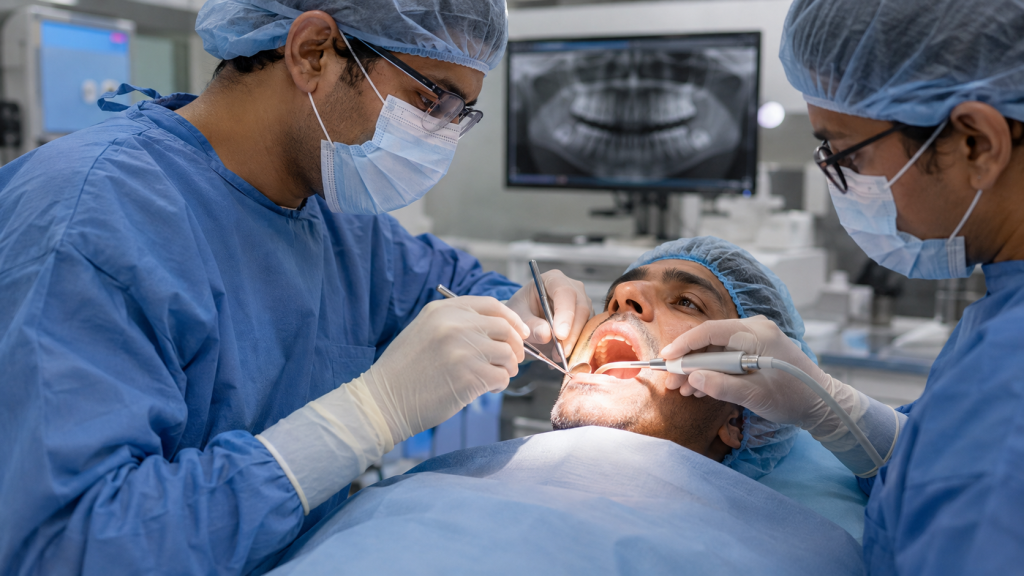
An oral and maxillofacial surgeon (OMS) is a dental specialist who has completed:
- A bachelor’s degree
- Dental school (BDS)
- 4 to 6 additional years of hospital-based surgical residency training
During this rigorous training, OMS residents work alongside medical residents in internal medicine, general surgery, anesthesiology, emergency medicine, and other specialties. This extensive training makes them uniquely qualified to administer all levels of anesthesia from local to general and perform complex surgeries that general dentists cannot.
Many oral and maxillofacial surgeons also pursue board certification, which requires passing rigorous written and oral examinations.
Conditions Treated by an Oral and Maxillofacial Surgeon
According to the American Association of Oral and Maxillofacial Surgeons (AAOMS), OMS specialists treat conditions including:
- Pain, infection, and disease of the head and neck region
- Trauma : facial bone fractures, skull fractures, and soft tissue injuries
- Pathology :benign and malignant tumors, salivary gland disease, and TMJ disorders
- Congenital and developmental deformities :cleft lip and palate, jaw irregularities
- Dentoalveolar issues : impacted teeth, problematic extractions
Condition vs Recommended Treatment
Common Procedures Performed
Here are the most frequently performed procedures by an oral surgeon:
1. Wisdom Tooth Surgery
Impacted wisdom teeth that fail to erupt properly or grow at odd angles can cause pain, infection, and damage to adjacent teeth. Oral surgeons are experts in surgically removing these problematic teeth safely and comfortably.
2. Dental Implants
Oral and maxillofacial surgeons pioneered the dental implant procedure. Their extensive surgical training allows them to place implants even in patients with complex cases including those with significant bone loss.
3. Corrective Jaw Surgery (Orthognathic Surgery)
When the upper and lower jaws don’t align properly, it can affect chewing, speaking, breathing, and even cause sleep apnea. Jaw surgery realigns the jaws to restore proper function and facial harmony.
4. Facial Trauma Treatment
Oral surgeons are essential members of facial trauma teams. They treat fractures of the jaws and facial bones, repair lacerations, and manage soft tissue injuries.
5. Oral Pathology Management
From benign cysts to cancerous tumors, oral and maxillofacial surgeons diagnose and surgically treat pathology of the mouth, head, and neck.
6. TMJ Treatment
Temporomandibular joint disorders can cause jaw pain, clicking, headaches, and difficulty opening the mouth. Oral surgeons provide both conservative and surgical treatment options.
7. Facial Reconstruction Surgery
Whether from trauma, tumor removal, or birth defects, facial reconstruction surgery restores both function and appearance.
When Should You Visit an Oral and Maxillofacial Surgeon?
Many patients wonder: “Do I need to see an oral surgeon or my regular dentist?” Here is a simple checklist to help you decide.
Checklist: Signs You Should See an Oral Surgeon
- You have impacted wisdom teeth causing pain, swelling, or infection
- You are missing teeth and considering dental implants
- You have persistent jaw pain, clicking, or difficulty opening your mouth
- You have experienced facial trauma a broken jaw, fractured cheekbone, or facial laceration
- You have lumps, sores, or unusual growths in your mouth that won’t heal
- Your jaws are misaligned, affecting your ability to chew, speak, or breathe properly
- Your dentist has referred you for surgical tooth extractions
- You need bone grafting before getting dentures or implants
- You have chronic facial pain that hasn’t responded to other treatments
If you checked any of these boxes, it is time to consult an oral and maxillofacial surgeon.
How Oral and Maxillofacial Surgery Differs from General Dentistry
This is one of the most common questions patients ask. Here is the simple difference:
In essence: your general dentist is your primary oral healthcare provider, while an oral surgeon is the specialist you see for surgical interventions.
Benefits of Early Diagnosis and Treatment
Delaying treatment for oral and facial conditions can have serious consequences. Here is why early intervention matters:
- Prevents complications :What starts as a simple wisdom tooth issue can lead to infections, cysts, or damage to adjacent teeth if left untreated
- Less invasive treatment : Early diagnosis often means simpler, less invasive procedures
- Better outcomes : Conditions like oral cancer are far more treatable when caught early
- Reduced pain and discomfort :Addressing problems early prevents them from becoming painful emergencies
- Cost savings :Treating a problem early is almost always more affordable than managing advanced disease
- Preserves natural teeth : Timely intervention can save teeth that might otherwise be lost
As the saying goes: “Don’t wait until it’s irreversible.”
Why Choose Dr. Chinmayee Kar in Cuttack?
If you are looking for a trusted oral and maxillofacial surgeon in Cuttack, Dr. Chinmayee Kar stands out as a top choice.
Dr. Chinmayee Chidanandini Kar holds an MDS in Oral and Maxillofacial Surgery a qualification that enables her to handle everything from routine dental care to complex oral surgical procedures with specialist-level expertise.
What Sets Her Apart
- Double qualification :MDS in Oral & Maxillofacial Surgery, making her uniquely qualified to manage both dental and surgical needs
- Outstanding reputation :Rated 4.9/5 on Justdial with over 1885+ reviews from satisfied patients
- Patient-centered approach :Patients consistently praise her ability to explain procedures in plain language and her gentle, caring touch
- Comprehensive care :From wisdom tooth surgery and dental implants to facial trauma treatment and jaw surgery, all under one roof
- Modern facility :Pearl Aesthetics in CDA Sector VI, Cuttack, is equipped with the latest technology
Located at C446, Eye Hospital Road, above Urban Cooperative Bank, CDA Sector VI, Cuttack, Odisha 753014, Dr. Kar’s practice is easily accessible to patients across the city.
Key Takeaways
- Oral and maxillofacial surgery is the surgical specialty of dentistry, treating conditions of the mouth, jaws, face, and neck
- Oral surgeons complete 4–6 years of hospital-based surgical training beyond dental school
- Common procedures include wisdom tooth surgery, dental implants, jaw surgery, facial trauma treatment, TMJ treatment, and oral pathology management
- See an oral surgeon if you have impacted teeth, jaw pain, facial injuries, missing teeth, or oral lumps
- Early diagnosis leads to better outcomes, less invasive treatment, and lower costs
- For expert care in Odisha, Dr. Chinmayee Kar is a leading oral and maxillofacial surgeon in Cuttack with an outstanding patient reputation
Frequently Asked Questions
1. Is oral and maxillofacial surgery painful?
Most procedures are performed under local anesthesia, IV sedation, or general anesthesia, so you will not feel pain during the surgery. After the procedure, your surgeon will prescribe appropriate pain medication to manage any discomfort during recovery.
2. How long does it take to recover from wisdom tooth surgery?
Most patients recover within 3 to 7 days for simple extractions. More complex impactions may take up to two weeks. Your oral surgeon will provide specific post-operative instructions to ensure a smooth recovery.
3. Can any dentist place dental implants?
While some general dentists place implants, oral and maxillofacial surgeons have significantly more surgical training and experience. They are better equipped to handle complex cases, including patients with bone loss or medical conditions that increase surgical risk.
4. When should my child see an oral surgeon?
Children may need to see an oral surgeon for impacted wisdom teeth, exposure of unerupted teeth, jaw growth problems, or cleft lip and palate repairs. Your child’s dentist or orthodontist will refer you when specialist care is needed.
5. Do I need a referral to see an oral and maxillofacial surgeon?
While many patients are referred by their general dentist or orthodontist, you can also schedule a consultation directly. At Dr. Chinmayee Kar’s clinic, new patients are welcome for evaluation and consultation.
Conclusion
Oral and maxillofacial surgery is a specialized field that addresses some of the most complex conditions affecting the face, mouth, jaws, and neck. From wisdom tooth surgery and dental implants to jaw correction and facial trauma treatment, an oral and maxillofacial surgeon plays a vital role in restoring both function and aesthetics.
If you or a loved one is experiencing any of the symptoms or conditions discussed in this guide, don’t wait. Early diagnosis and treatment can make all the difference.
For residents of Odisha, Dr. Chinmayee Kar is a trusted oral and maxillofacial surgeon in Cuttack with the expertise, experience, and patient-centered approach you deserve.
Your smile and your health deserve expert care.
📞 Book Your Consultation Today
Are you experiencing jaw pain, impacted wisdom teeth, or considering dental implants? Don’t wait for the problem to worsen.
Dr. Chinmayee Kar
Pearl Aesthetics, C446, Eye Hospital Road, above Urban Cooperative Bank, CDA Sector VI, Cuttack, Odisha 753014.
Contact : – +91 8895434284