
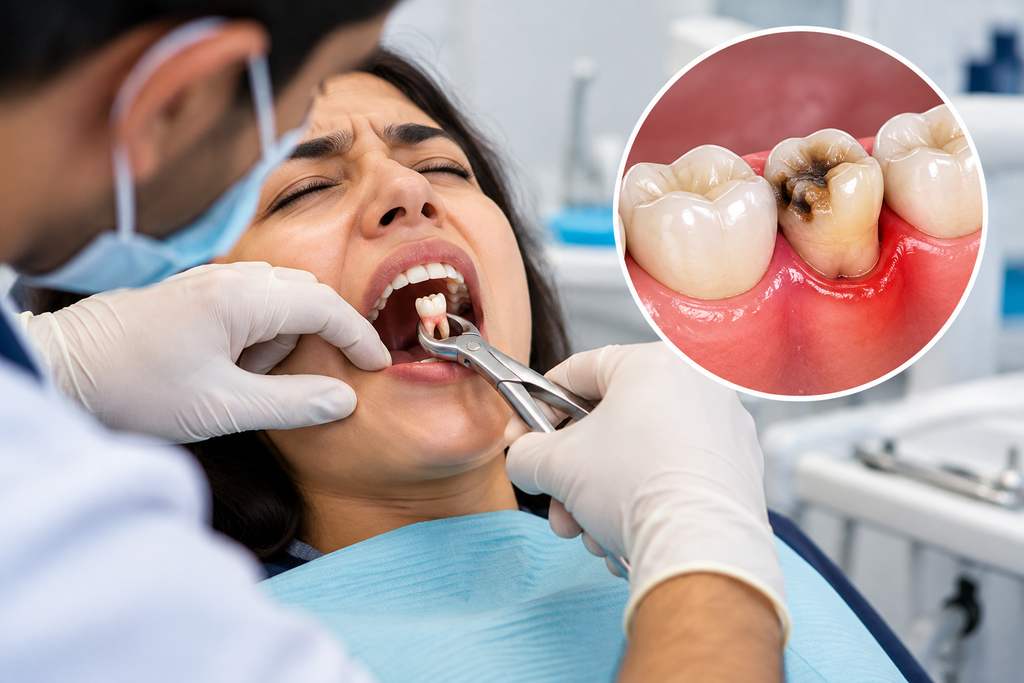
A toothache can be unsettling. It interrupts your sleep, makes eating difficult, and often leaves you wondering whether the tooth can be saved or needs to be removed.
Here is the reassuring truth: tooth pain does not automatically mean you need an extraction. Many painful or damaged teeth can be treated with fillings, root canal therapy, or other restorative procedures. Tooth extraction is typically considered only when a tooth cannot be safely restored or when leaving it in place could harm your oral health. This is why a professional dental examination is essential before any treatment decision is made.
If you are in Bhubaneswar and searching for reliable guidance on tooth removal treatment in Cuttack, this article will help you understand the signs that warrant a dental visit, the situations where extraction may be necessary, and the alternatives that could save your natural tooth.
What Is Tooth Extraction?
Tooth extraction is the removal of a tooth from its socket in the jawbone. It is one of the most common dental procedures, and when performed by a qualified dentist, it is generally safe and straightforward.
There are two main types:
- Simple extraction: Used for a tooth that is visible above the gumline. The dentist loosens the tooth with special instruments and removes it. Local anesthesia is used to keep you comfortable.
- Surgical extraction: Required when a tooth is broken below the gumline, impacted, or otherwise difficult to access. A small incision may be made in the gum to reach the tooth. This is more common for wisdom teeth.
When Is Tooth Extraction Necessary?
Dentists generally prefer to save natural teeth whenever possible. However, extraction may be recommended in certain clinical situations:
- Severe tooth decay — When decay has destroyed so much of the tooth structure that a filling or crown cannot restore it.
- Advanced gum disease and loose teeth — Periodontal disease can cause significant bone loss, making a tooth mobile and non-salvageable.
- Severe tooth infection or abscess — If an infection has spread beyond the tooth and root canal treatment is unlikely to resolve it, extraction may be necessary to prevent the infection from spreading further.
- A badly broken or fractured tooth — A crack that extends below the gumline often cannot be repaired.
- Impacted wisdom teeth — Wisdom teeth that are trapped under the gum or bone can cause pain, infection, cysts, or damage to adjacent teeth.
- Overcrowding before orthodontic treatment — Sometimes a tooth is removed to create space for proper alignment.
- Teeth that cannot be restored — When fillings, crowns, and root canal treatment have all been considered and are not viable options.
- Retained baby teeth or abnormal tooth development — In some cases, a baby tooth that does not fall out naturally or an abnormally developing tooth may need to be removed.
A dentist will evaluate your specific situation using clinical examination and X-rays before recommending extraction.
10 Signs You May Need a Tooth Extraction
The following symptoms do not automatically mean you need an extraction. However, they are signs that you should see a dentist for a proper evaluation:
- Persistent or severe toothache — Pain that lingers, worsens at night, or radiates to your jaw or ear.
- Swelling around the tooth or gums — Swelling that does not improve or keeps returning.
- Recurrent dental infection — Repeated episodes of infection in the same tooth, even after treatment.
- A severely broken tooth — A tooth that has cracked or broken in a way that exposes the inner layers.
- A very loose permanent tooth — A permanent tooth that moves noticeably when you touch it.
- Difficulty chewing — Pain or discomfort when biting or chewing on one side.
- Pain or swelling around a wisdom tooth — This may include red, inflamed gums, jaw pain, or difficulty opening your mouth.
Each of these situations requires a dental examination to determine the appropriate treatment whether that is saving the tooth or removing it.
Can a Tooth Be Saved Instead of Extracted?
In many cases, yes. Dentists consider several tooth-saving options before recommending extraction:
- Dental fillings — For cavities that have not reached the pulp.
- Root canal treatment — Removes infected pulp from inside the tooth and seals it, allowing the natural tooth to remain in place.
- Dental crowns — Cover and protect a weakened or cracked tooth.
- Periodontal treatment — Deep cleaning and gum therapy can help stabilize a tooth affected by gum disease.
The guiding principle in modern dentistry is to preserve the natural tooth whenever it can be predictably restored. Extraction is reserved for situations where these options are not viable.
Tooth Extraction vs Root Canal Treatment
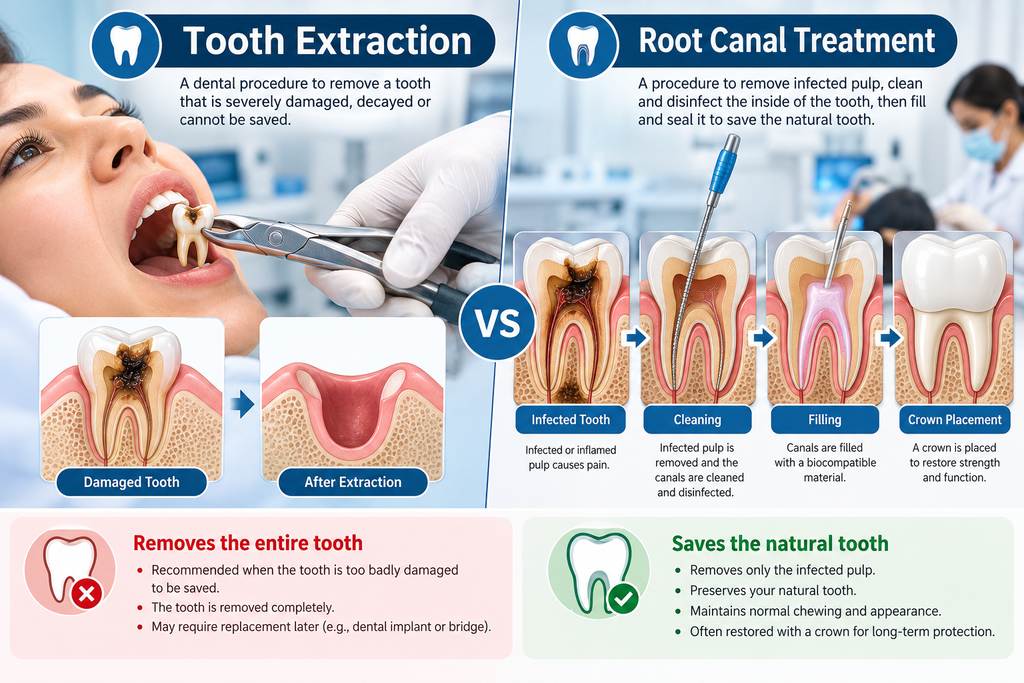
| Feature | Root Canal Treatment | Tooth Extraction |
|---|---|---|
| Purpose | Removes infected pulp to save the tooth | Removes the entire tooth |
| When recommended | Tooth is infected but restorable | Tooth is non-restorable or poses a health risk |
| Natural tooth preserved? | Yes | No |
| Approach | Clean, fill, and seal the root canal; place a crown | Remove the tooth from its socket |
| After treatment | Tooth functions normally with a crown | May need a bridge, implant, or denture to replace it |
Root canal treatment is generally preferred when the tooth can be saved because it preserves your natural tooth and helps maintain jawbone health. However, if the tooth is severely fractured or the infection cannot be controlled, extraction may be the safer option.
What Happens During a Tooth Extraction?
A typical extraction follows these steps:
- Examination and X-rays — The dentist assesses the tooth and surrounding structures.
- Local anesthesia — The area is numbed so you do not feel pain during the procedure.
- Tooth removal — The dentist loosens and removes the tooth using appropriate instruments.
- Cleaning the area — The socket is cleaned, and a gauze pad is placed to control bleeding.
- Aftercare instructions — You receive guidance on pain management, diet, and oral hygiene.
The procedure is usually completed within 20 to 40 minutes for a simple extraction.
What to Expect After Tooth Extraction
Recovery is typically straightforward if you follow your dentist’s instructions:
- Mild pain and swelling — This is normal and usually improves within a few days.
- Bleeding — Some bleeding is expected initially; biting on gauze helps control it.
- Soft foods — Stick to soft, cool foods for the first day or two.
- Oral hygiene — Keep the area clean but avoid vigorous rinsing for the first 24 hours.
- Avoid smoking and tobacco — These can delay healing and increase the risk of complications.
- Follow your dentist’s advice — Take any prescribed medications as directed.
- When to contact your dentist — If pain worsens after a few days, bleeding does not stop, or you develop a fever, reach out promptly.
When Should You See a Dentist Immediately?
Some situations require urgent dental attention. Contact a dentist without delay if you experience:
- Facial swelling that is spreading
- Difficulty breathing or swallowing
- Fever along with dental swelling
- Bleeding that does not stop
- Severe, worsening pain
- Signs of a spreading infection, such as swelling under the jaw or down the neck
These symptoms may indicate a serious infection that needs prompt treatment.
How to Find the Right Dentist for Tooth Extraction in Bhubaneswar
When choosing a dentist for tooth extraction, consider the following:
- Qualifications and experience — Look for a dentist with relevant training and a track record in oral surgery.
- Proper diagnosis and imaging — A good dentist will take X-rays when needed and explain the findings.
- Tooth-saving options — They should discuss alternatives to extraction before recommending removal.
- Infection-control standards — The clinic should follow strict sterilization protocols.
- Transparent communication — You should understand the treatment plan and cost before proceeding.
- Follow-up care — Post-extraction support is important for smooth healing.
Taking the time to choose the right dentist can make your experience safer and more comfortable.
Frequently Asked Questions
1. How do I know if my tooth needs to be extracted?
Ans :- You cannot determine this on your own. A dentist will examine the tooth, take X-rays if needed, and evaluate whether it can be restored. Extraction is recommended only when saving the tooth is not predictably possible.
2. Can a badly infected tooth be saved?
Ans :- In many cases, yes. Root canal treatment can often resolve an infection and save the tooth. However, if the infection is severe or the tooth structure is too damaged, extraction may be necessary.
3. Is tooth extraction painful?
Ans :- The procedure is performed under local anesthesia, so you should not feel pain during the extraction. Some soreness and swelling afterward are normal and manageable with medication.
4. How long does it take to recover?
Ans :- Most people feel better within a few days. Complete healing of the extraction site typically takes one to two weeks. Following your dentist’s aftercare instructions helps speed recovery.
5. Can a broken tooth be extracted?
Ans :- Yes, if a broken tooth cannot be repaired with a filling or crown, extraction may be recommended. Your dentist will assess the extent of the damage first.
6. When should wisdom teeth be removed?
Ans :- Wisdom teeth may need removal if they are impacted, causing pain, infection, or damaging nearby teeth. Not all wisdom teeth require extraction — your dentist will advise based on your situation.
7. What should I do after tooth extraction?
Ans :- Follow your dentist’s instructions carefully: bite on gauze as directed, avoid rinsing vigorously for 24 hours, eat soft foods, avoid smoking, and take medications as prescribed. Contact your dentist if you notice worsening pain or unusual symptoms.
Conclusion
Tooth extraction is not something to fear, but it is also not a decision to take lightly. The signs discussed in this article persistent pain, swelling, infection, a broken tooth, or a loose permanent tooth are signals that you need a professional dental evaluation. They do not automatically mean extraction is required. In many cases, tooth-saving treatments like root canal therapy or crowns can preserve your natural tooth. When extraction is necessary, a qualified dentist will ensure the procedure is safe, comfortable, and followed by appropriate aftercare.
Looking for a Tooth Treatment Specialist in Cuttack?
Finding the right dental professional matters. A qualified specialist can assess whether your tooth can be saved or whether extraction is truly necessary. They will explain your options clearly, perform the procedure with care, and guide you through recovery. Whether you need a routine examination or a more complex tooth removal treatment in Cuttack, consulting an experienced dentist is the first step toward protecting your oral health.
Meet Your Dental Expert: Dr. Chinmayee Kar

Dr. Chinmayee Kar is a highly experienced dental surgeon with BDS and MDS qualifications and over 21 years of clinical experience. with expertise in dental care, Dr. Kar provides comprehensive evaluations and personalised treatment plans for patients dealing with tooth pain, infection, and complex dental conditions. Her patient-focused approach ensures that every treatment decision including whether to save or extract a tooth is based on a thorough clinical assessment and your individual needs.
Experiencing persistent tooth pain, swelling, infection, severe decay, or a damaged tooth? Do not ignore the signs. Schedule a dental evaluation today and take the first step toward protecting your smile and your overall health.
Visit Pearl Aesthetics | Dental Clinic | Implant
Address: C446, Eye Hospital Road, above Urban Cooperative Bank, CDA Sector VI, Kataka, Odisha 753014.
Visit Location :- https://maps.app.goo.gl/c7V6dMwHrBxicW938