
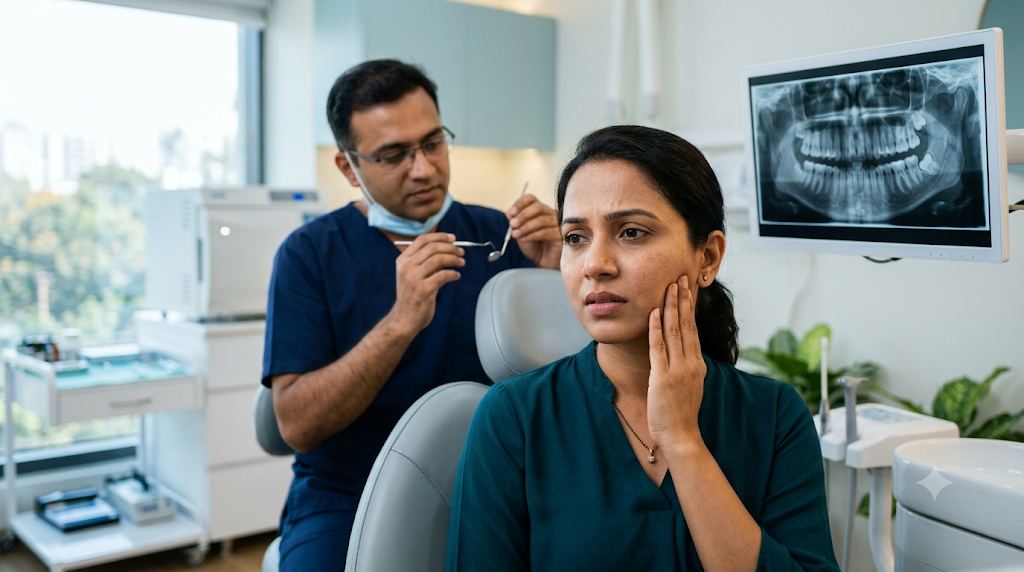
It starts as a dull ache at the very back of your mouth. Maybe it only hurts when you chew on that side, or perhaps you notice a strange, persistent taste that doesn’t go away with brushing. Wisdom teeth your third molars are the last teeth to emerge, usually between ages 17 and 21. For some people, they come through without any trouble at all. For others, they can become impacted, meaning they get stuck under the gum or grow in at an awkward angle that makes them difficult to clean. So how do you know when a wisdom tooth may need professional evaluation or removal? If you are searching for a Wisdom Tooth Removal specialist in Cuttack, understanding the warning signs can help you decide when it’s time to seek care.
What Are Wisdom Teeth?
Wisdom teeth are the four molars located at the very back of your upper and lower jaws. They are called “wisdom” teeth because they typically appear later than your other adult teeth, during the transition into adulthood.
In many people, the jaw simply doesn’t have enough room to accommodate these late-arriving teeth. When there isn’t sufficient space, a wisdom tooth can become impacted — trapped beneath the gum tissue or unable to erupt into a normal position. A partially erupted wisdom tooth can create a small opening in the gum where bacteria and food particles become trapped, potentially leading to inflammation, infection, or decay over time.
Warning Signs That May Require Evaluation
While not every wisdom tooth causes problems, certain symptoms may indicate that something needs professional attention. Here are five warning signs to watch for.
Persistent or Recurrent Wisdom Tooth Pain
Occasional discomfort as a tooth pushes through the gum can be normal. However, ongoing or repeatedly returning pain at the back of your mouth may signal an underlying issue that warrants a dental examination.
This type of pain can arise from several sources: an impacted tooth pressing against neighboring structures, inflammation of the gum tissue covering a partially erupted tooth, or a developing infection. The discomfort might feel like a dull pressure, a sharp ache when biting down, or a throbbing sensation that radiates toward your ear.
Pain that comes and goes can be tempting to ignore, especially when it subsides on its own. But recurring episodes may indicate that the problem is not resolving — it is simply flaring and settling in a cycle that could continue or worsen.
Swelling, Redness, or Tender Gums
If you notice that the gum tissue around your wisdom tooth looks red, feels tender, or appears swollen, this may be a sign of inflammation. A common condition called pericoronitis occurs when the gum flap over a partially erupted wisdom tooth becomes irritated and inflamed.
You might notice that the area feels sensitive to touch, or that your gums bleed slightly when you brush near the back of your mouth. In some cases, the swelling can make it feel as though your back teeth don’t meet quite right.
Recurring inflammation around a wisdom tooth deserves professional evaluation. While a single mild episode might settle with careful oral hygiene, repeated flares suggest that the area is difficult to keep clean and may benefit from further assessment.
Difficulty Opening Your Mouth or Chewing
Jaw stiffness or difficulty opening your mouth fully can sometimes accompany wisdom tooth problems. You might find that yawning, chewing, or even speaking feels uncomfortable or restricted.
This can happen when inflammation or infection in the area affects the surrounding muscles that control jaw movement. You may also notice discomfort specifically when chewing on the side where the wisdom tooth is located.
If this symptom persists or worsens — particularly if it begins to interfere with eating or speaking — it is worth having it assessed rather than waiting for it to resolve on its own.
Bad Breath or Unpleasant Taste
Persistent bad breath or a recurring unpleasant taste near the back of your mouth can sometimes indicate a problem with a wisdom tooth. When a tooth is partially erupted, food particles and bacteria can become trapped beneath the gum flap, creating an environment that produces odor and an unpleasant taste.
It is important to note that bad breath and bad taste have many possible causes, ranging from general oral hygiene to other dental conditions. However, when these symptoms are localized to the area around a wisdom tooth and do not improve with thorough brushing and rinsing, they may be a sign that the tooth is difficult to keep clean and is harboring bacteria.
Repeated Infections or Problems Around the Tooth
One of the most common reasons a dentist may recommend removing a wisdom tooth is repeated episodes of infection or gum problems around the tooth. If you have experienced multiple rounds of swelling, pain, or tenderness in the same area, this pattern suggests that the underlying issue is not resolving on its own.
An infection at the base of a wisdom tooth root, gum disease affecting the area, or decay in a partially erupted tooth that cannot be easily repaired are all situations where extraction may be considered. The decision depends on a professional examination and, when appropriate, dental imaging to see the position of the tooth and its relationship to surrounding structures.
Does Every Wisdom Tooth Need to Be Removed?
This is one of the most common questions patients ask — and the answer is no. Not every wisdom tooth requires extraction.
A wisdom tooth that is healthy, fully erupted, positioned correctly, and able to be cleaned as part of your daily routine may not need to be removed. Some dentists and oral surgeons recommend a conservative approach for asymptomatic wisdom teeth, monitoring them over time rather than removing them preemptively.
However, a dentist may consider removal when factors such as these are present:
- The tooth is impacted or unable to erupt normally
- There is recurring pain or infection
- The tooth shows decay that cannot be repaired
- Gum disease affects the area around the tooth
- The wisdom tooth is damaging neighboring teeth
- There is not enough space, making the area difficult to clean
- Dental imaging reveals cysts or other pathology
The decision is not always straightforward. Some dental professionals favor early removal because younger patients tend to heal more quickly and the procedure may be less complex before roots are fully formed. Others recommend monitoring asymptomatic teeth and intervening only if problems develop. An examination and imaging help your dentist or oral surgeon determine what is appropriate for your specific situation.
What Happens During a Wisdom Tooth Evaluation?
If you schedule a consultation for wisdom tooth concerns, here is a general idea of what to expect.
Your dentist or oral surgeon in Cuttack will begin by asking about your symptoms and dental history when the pain started, how often it occurs, and whether you have noticed swelling or other changes. They will then examine your mouth and gums, assessing the wisdom tooth and the surrounding teeth.
Dental X-rays are typically part of the evaluation. These images show the position of the wisdom tooth, its roots, and its relationship to nearby teeth, nerves, and bone. In some cases, a more detailed scan may be recommended if the tooth is very close to important structures.
Based on these findings, your dentist will discuss whether monitoring, treatment, or removal may be appropriate. If removal is recommended, they will explain the reasoning and what the procedure involves.
When Is Wisdom Tooth Removal Urgent?
While many wisdom tooth problems can be addressed at a scheduled appointment, certain symptoms require prompt attention.
Seek same-day or urgent care if you experience:
- Facial or jaw swelling that is rapidly increasing
- Fever alongside dental pain or swelling
- Difficulty swallowing
- Difficulty breathing
- Significant difficulty opening your mouth
- Severe or rapidly worsening pain
- Signs of spreading infection, such as swelling that extends toward your neck
Difficulty breathing or swallowing associated with significant swelling can represent a medical emergency. In these situations, immediate medical attention is necessary — not a wait-and-see approach.
Wisdom Tooth Removal vs. Monitoring
The following table offers a general guide. It is not a substitute for a professional dental examination.
| Situation | Possible Approach |
|---|---|
| Healthy, properly positioned wisdom tooth | Monitoring may be appropriate |
| Occasional mild symptoms | Dental evaluation |
| Recurrent inflammation or infection | Dentist may consider removal |
| Impacted tooth causing problems | Removal may be recommended |
| Severe infection symptoms | Prompt professional attention |
Why You Shouldn’t Ignore Wisdom Tooth Problems
Repeatedly ignoring symptoms can allow dental problems to persist or worsen over time. An area around a wisdom tooth that is difficult to clean may become a site of recurring gum inflammation, tooth decay, or infection. In some cases, problems affecting a wisdom tooth can also impact the health of the neighboring molar.
This does not mean that every twinge of discomfort will lead to a serious outcome. Many mild symptoms settle on their own. But symptoms that recur, persist, or interfere with daily activities are worth having checked. Early evaluation can provide clarity and help you understand your options.
How to Prepare for a Wisdom Tooth Consultation
A little preparation can help you make the most of your appointment. Consider noting:
- When your symptoms started and whether they are constant or intermittent
- What makes the pain better or worse — chewing, hot or cold drinks, opening your mouth
- Any swelling, bad taste, or bad breath you have noticed
- Previous dental problems or treatments in the area
- Medications or health conditions that may be relevant
- Previous dental X-rays, if you have them available
Frequently Asked Questions
1. What are the signs that a wisdom tooth needs to be removed?
Ans :- Signs may include persistent pain, recurrent swelling or infection around the tooth, difficulty chewing or opening your mouth, and evidence of decay or damage to nearby teeth. However, only a dental examination and imaging can determine whether removal is appropriate.
2. Does wisdom tooth pain always mean extraction is necessary?
Ans :- No. Wisdom tooth pain can have various causes, and not every painful wisdom tooth requires removal. Some symptoms may resolve with professional cleaning or treatment of inflammation. A dentist can assess whether the tooth can be monitored or whether extraction may be beneficial.
3. What is an impacted wisdom tooth?
Ans :- An impacted wisdom tooth is one that cannot erupt normally because of lack of space, an awkward angle, or obstruction by other teeth or bone. It may remain fully or partially trapped beneath the gum, which can increase the risk of infection, decay, and other problems.
4. Can a wisdom tooth cause bad breath?
Ans :- Yes, in some cases. A partially erupted wisdom tooth can create a pocket where food particles and bacteria become trapped, potentially leading to persistent bad breath or an unpleasant taste. However, bad breath has many possible causes, and a dental evaluation can help identify the source.
5. Can wisdom teeth cause gum infection?
Ans :- Yes. When a wisdom tooth is partially erupted, the gum flap covering it can become inflamed — a condition called pericoronitis. This can cause swelling, tenderness, and infection. Recurring episodes may indicate that the area is difficult to keep clean.
When should I see a dentist for wisdom tooth pain?
Ans :- See a dentist if you have persistent or recurring pain, swelling, difficulty chewing, or other symptoms that interfere with daily activities. Seek urgent care for rapidly increasing swelling, fever, difficulty swallowing or breathing, or severe worsening pain.
Conclusion
Wisdom tooth problems can range from mild, temporary discomfort to recurring inflammation, infection, or impaction that affects surrounding teeth. The key is knowing when to seek professional guidance. Not every wisdom tooth needs to be removed — the decision should be based on a thorough dental examination and, when appropriate, imaging. If you are experiencing persistent, recurrent, or concerning symptoms, consulting a qualified dentist or Wisdom Tooth Removal specialist in Cuttack can help you understand your options and receive appropriate care.
Meet Your Doctor : Dr. Chinmayee Chidanandini Kar

Dentist, Oral & Maxillofacial Surgeon
BDS, MDS.
When a wisdom tooth starts causing trouble, the person you want in your corner is someone who has spent years handling exactly these situations — and that is precisely what Dr. Chinmayee Chidanandini Kar brings to her patients in Cuttack, Odisha.
Dr. Kar is a leading Dental Surgeon and Oral & Maxillofacial Surgeon whose practice spans everything from dental implants and teeth extraction to impaction management, minor oral surgeries, and facial reconstruction. She completed both her Bachelor of Dental Surgery and Master of Dental Surgery at the Institute of Dental Sciences, SOA University, and has since served as a Maxillofacial Surgeon at SCB Medical College and as a Senior Dentist at Pearl Aesthetics Dental Clinic.
What sets her approach apart is breadth of training combined with a clear focus on the patient. She has completed a Fellowship in Advanced Endodontics (Asian Institute of Advanced Dentistry, Hyderabad) and a Fellowship in Advanced Implant Programme, along with hands-on training in advanced bleaching and aesthetics. She has also been part of Operation Smile’s Cleft and Craniofacial Programme, reflecting a genuine commitment to reconstructive and humanitarian care.
Patients consistently value her clear explanations, methodical assessment, and reassuring manner — qualities that matter when you are deciding whether a wisdom tooth needs attention. If you are looking for a Wisdom Tooth Removal specialist in Cuttack, Dr. Kar’s combination of surgical expertise, advanced training, and patient-first care makes her a trusted choice.
Book Your Wisdom Tooth Consultation Today
Dr. Chinmayee Chidanandini Kar
Dentist, Oral & Maxillofacial Surgeon
BDS, MDS.
Clinic: Pragati Enclave
Plot No. D5-B, CDA Sector VI, Kataka, Odisha 753014
Call: +91 70088 01645
Book an Appointment — Reach out today to schedule a consultation and get expert guidance on your wisdom tooth concerns.